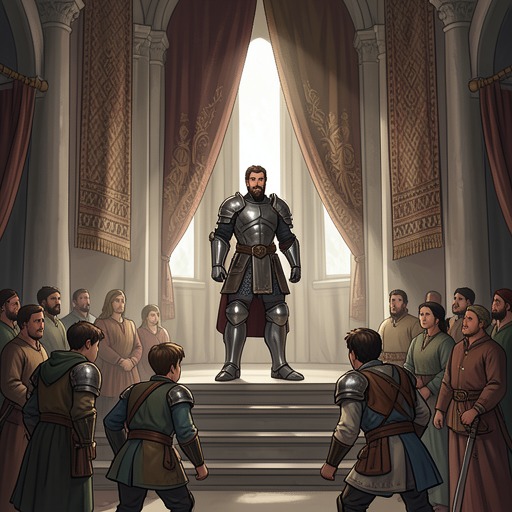
Theseus's conquest of Thebes
The Canterbury TalesTheseus's conquest of Thebes is both a military victory and an act of corrective justice. The campaign begins with triumph already shadowed by grief: the defeated women appeal to Theseus, and their suffering redirects his power toward Creon, whose rule has denied the slain proper burial. Theseus therefore conquers not merely to enlarge his authority, but to punish Creon and restore the dead to the living through funeral rites.
The Plea That Redirects Victory
The event is framed by the women’s supplication. They address Theseus as the lord whom Fortune has chosen to live as conqueror, but insist that his glory and honor are not opposed to their grief. Their appeal separates legitimate victory from the misery produced by Creon’s conduct: the conqueror’s reputation will not be diminished if he responds to those whom war has left bereaved.
Theseus receives the petition with immediate compassion. When the women ask him to have mercy on the wretched and open his heart to their grief, he dismounts at once, moved by pity and feeling that his heart is nearly broken. The gesture matters because it converts a distant military ruler into a witness of suffering. Before the campaign is narrated as battle, it is established as a response to faces, voices, and mourning.
The March Against Creon
The women’s complaint identifies the wrong that must be answered: Creon has left the bodies of their kinsmen unburied. Theseus is told how Creon has been served his just deserts and how death awaits the Theban king. Without delay, Theseus displays his banner and rides toward Thebes with his entire host on every side. The banner turns compassion into public action, while the assembled army gives that compassion the force of law and conquest.
The campaign is presented in compressed, decisive movement. Theseus reaches Thebes and alights upon a field where he is set to fight. The narration does not linger over strategy or the duration of the battle; it concentrates on the moral clarity of the confrontation. Creon, the Theban king, is defeated and slain in open battle, in a manner described as befitting a knight, while his men are put to flight.
Assault and Destruction of Thebes
Victory over Creon is followed by the capture of the city itself. Theseus wins Thebes by assault and tears it down, destroying its walls, beams, and rafters. The physical dismantling of the city gives material form to the defeat of Creon’s rule: the king’s power is not simply transferred to another sovereign but violently erased from the urban structure that sustained it.
The destruction also gives the event its harshest edge. Theseus’s response is compassionate toward the bereaved women, yet uncompromising toward the enemy city. The campaign joins pity and devastation in a single sequence: the suffering of the women calls forth mercy, but mercy is enacted through war, the killing of Creon, the routing of his forces, and the demolition of Thebes.
Restoration of the Dead
The conquest reaches its ethical purpose when Theseus restores the bones of the slain to the women. After destroying the city, he returns the remains of their kinsmen so that they may receive the obsequies customary in that age. The action does not undo death, and it cannot restore the families’ former lives, but it repairs the dishonor imposed upon the dead by denying them burial.
This final act changes the meaning of the campaign. The dead are no longer anonymous casualties of a defeated city; they are recovered kinsmen, returned to those who mourn them. Theseus’s victory therefore culminates not in possession of Theban wealth or territory, but in funeral recognition. His conquest answers Creon’s violence by restoring the rites through which the community acknowledges both death and kinship.
Narrative and Ethical Significance
The event follows a clear movement from appeal to action, from action to punishment, and from punishment to restoration. Its value shifts from the women’s helpless grief to Theseus’s pity, then to armed victory, and finally to a limited recovery of dignity. The rapid narration of the fighting keeps attention on the cause and consequence of violence rather than on military spectacle.
Theseus’s conquest also defines his model of rule. He is powerful enough to destroy a city, but his decisive quality is that power remains answerable to the grief of others. The women’s plea supplies the moral cause; Theseus’s dismounting supplies the human response; the march and battle supply enforcement; and the return of the bones supplies the promised justice. The campaign thus presents chivalric authority as most honorable when victory becomes protection for the vulnerable and restitution for the dishonored dead.